Click image to learn more
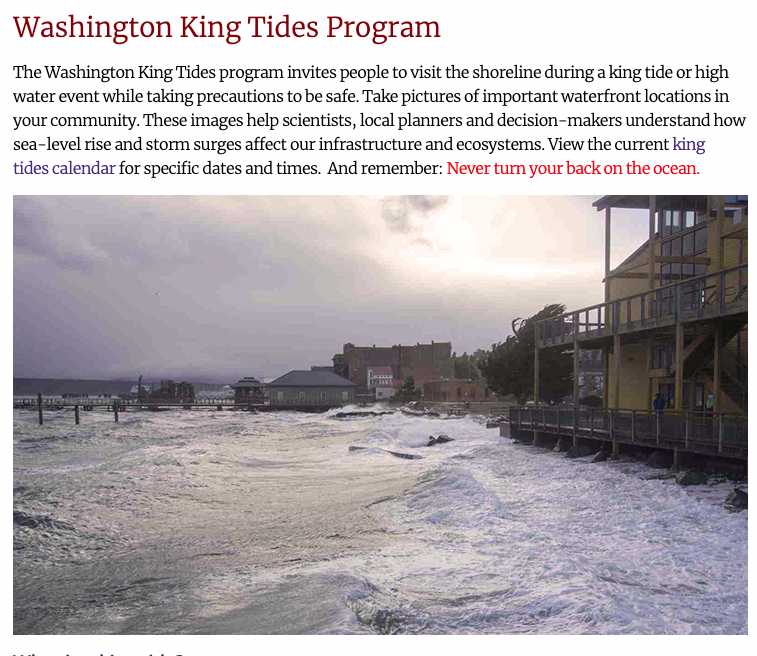
Washington Sea Grant seeks photographs from citizens to help document the effects of King Tides in different areas of our waterfront, and to help understand and plan for the effects of higher sea levels and other flooding events.
Please post king tides photos to the MyCoast
website or use the MyCoast app.
It is helpful to take pictures where the impact of the tide can be gauged against familiar landmarks that do not move with the tides like buildings, roads, sea walls, and beach infrastructure such as boat ramps, piers and pilings.
What is a king tide?
In the simplest terms, king tide is colloquially used to describe an extremely high tide. Ordinary tides are caused by the gravitational pull between the Earth and the moon; king tides happen when astronomical events amplify that pull.
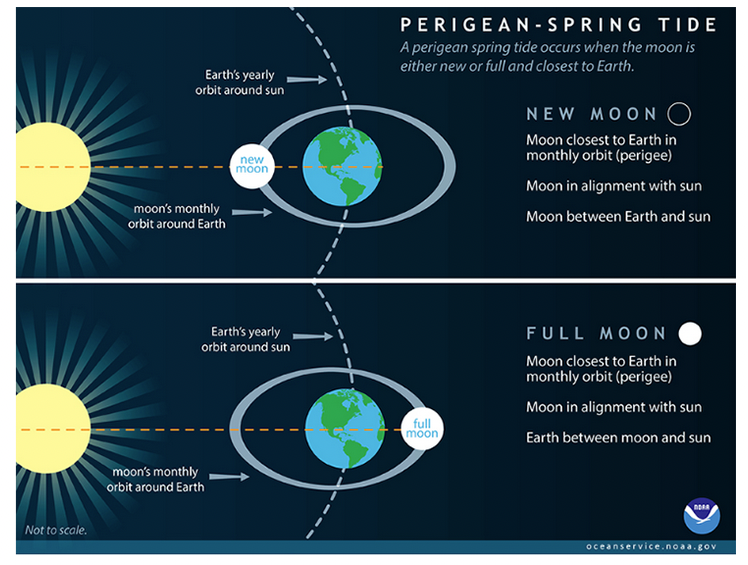
These astronomical events come in a couple different flavors. One type of king tide starts with a spring tide, which takes place when the Earth, moon and sun are aligned. While the moon generally has a bigger influence on Earth’s tides, the sun also has gravitational effects. When the moon and sun are aligned, their gravitational effects compound, and the high tides become a little higher. Spring tides occur twice each lunar cycle (when the moon is either new or full). These already higher-than-average tides are exacerbated when spring tides coincide with the moon in perigee, which means the moon is particularly close to Earth and so has an even greater gravitational pull on the ocean. The perigee happens at the same time as a spring tide three or four times a year in both spring and fall, creating the most common type of king tide known as perigean spring tides.
King tides also happen when the sun is closest to the Earth in its orbit – a position called perihelion. The sun reaches this position in early January each year. Similarly, in early July, the sun is furthest away from Earth – a position called aphelion – and the gravitational pull is weakened, resulting in smaller tides.