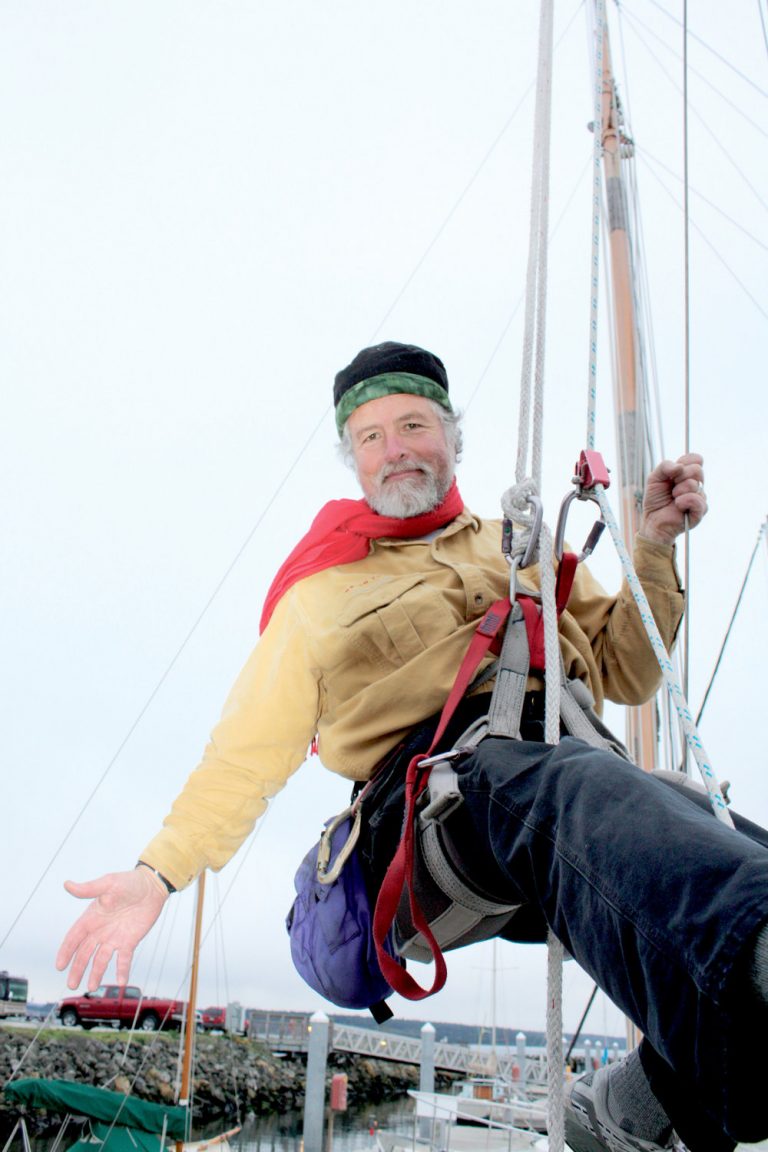
Brion Toss was honored with a lifetime achievement award by the NWMC in 2019. Brion knew he did not have much longer on this planet and his acceptance speech reminded us about what is important.
BRION’S LIFETIME ACHIEVEMENT AWARD SPEECH
Some years ago I was working with our dear friend Jim, laying out and installing his mainsheet, vang, and related items.
Jim is an actual rocket scientist, and he was confident he could handle the complexities of a bit of running rigging. We were making good progress, balancing overlapping and competing requirements of the components, something that is intrinsic to the process. But after a few hours had passed, Jim put down his tools and said,
“This is hard. This is a lot harder than rocket science.”
He explained that, in his usual work, he did very complex calculations about a very limited part of the project, as part of a huge team, each member of which was participating in a similarly limited fashion, whereas we had to understand the function of every component of our project, and how each component interacted with all the others, as well as the nature and magnitude of the various loads, as well as the properties of the various materials we were using. Basically, in order to do a good job on anything, we had to understand everything. And after all of that, we had to figure out how to get all the leads to their belays, then to drill, cut, reeve, and splice properly, in order to finish the work.
This is the level of knowledge and skill that the best shipwrights, sailmakers, machinists, riggers, and other marine artisans possess as a matter of course.
Even practitioners of specialized, focused arts like caulking and welding, optimally, understand the context of their work, and they inform that work to the depth of their understanding, to the benefit of the greater project.
None of these artisans are remunerated like rocket scientists. Far from it. Instead, they earn what money they can, and are additionally compensated with an immediate, visceral, profound fulfillment and camaraderie that I doubt is commonplace at NASA.
Here, in this unlikely place called Port Townsend, artisans have banded together, and bonded, “…standing together,” as my spouse puts it, “to preserve traditions, as well as to keep the fire of creativity burning.”
You, the members of this glorious, deeply odd collaborative, this wonderfully cross-pollinated tribe, took Christian and I in, over 30 years ago. You educated me where I was in ignorance, corrected me where I was mistaken, and redeemed me with your skill, your trust, and your love.
A sizeable percentage of you are far more qualified to receive this award than I am, so I take no great pride in receiving it. It is a bit surreal to be recognized and honored by those whose accomplishments surpass my own.
But thank you, all of you consummate professionals, you gifted, hardworking, interdependent practitioners of the maritime arts. Thank you for making our home a wonderful place. Thank you to David Jackson for the nomination, and to the award’s sponsors for going along with him.
Thank you to my magnificent Christian, for keeping me and the business alive, while giving me so much to live for.
Thank you to my family, for showing me what love is.
Thank you to my friends, colleagues, and clients — some of you have been all three — for enriching our lives on a daily basis.
Thank you to Ian Weedman, who returned 18 years after serving his apprenticeship, knowing, as you also know, how powerfully fulfilling it can be to live and work in this community.
Thank you to Jen Bates, who also returned to rigging after a comparable-length hiatus, during which she undertook the far more challenging, complex task of rearing two children.
Thank you to all the riggers I have been blessed to have worked with, in boats, in ships, in buildings, and in forests, for helping me to see and comprehend the power and beauty of this art.
There is a Robert Frost poem called Two Tramps in Mud Time, in which the narrator seeks to show that wages are not the most rewarding aspect of why we work. He concludes the poem by saying that his object is to,
…unite my vocation and my avocation, as my two eyes make one in sight.
Only where love and need are one,
And the work is play for mortal stakes
Is the deed ever really done,
For heaven and the future’s sakes.”
Thinking of our lives here, and of those who share this place with us, I am also reminded of a poem by Confucius, of all people. Slightly amended, it goes like this:
Life leads thoughtful people on a path of many windings.
Here the way is checked,
There it runs straight again.
Here winged thoughts may pour freely forth in words.
There the heavy burden of knowledge must be shut away in silence.
But when people love one another, in their inmost hearts,
They can shatter even the strength of iron, or of bronze.
And when people understand one another, in their inmost hearts,
Their words are sweet and strong, like the fragrance of orchids.
Thank you for your love, and for your understanding.